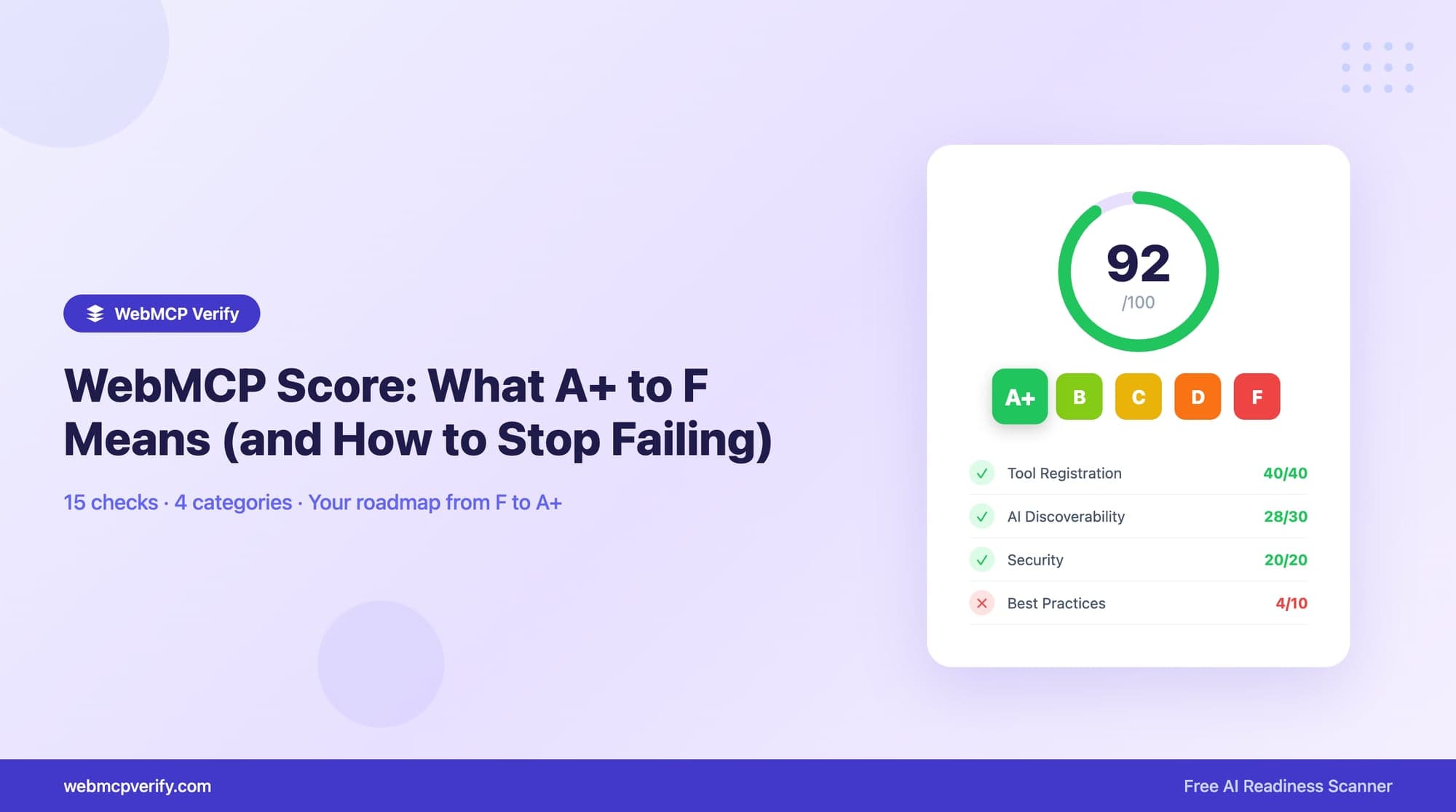
Updated October 11, 2026. A WebMCP Verify score summarizes this site's heuristic ruleset. It is not an official WebMCP certification, a browser compatibility guarantee, a security audit or a prediction of search ranking.
Read the version before the grade
This guide describes ruleset 2026-10-05. A report records its scan time and rule version. Older or unknown versions should not be silently interpreted as current results. A rescan can also differ because the page, network response or loaded scripts changed.
| Grade | Score |
|---|---|
| A+ | 97–100 |
| A | 90–96 |
| B | 80–89 |
| C | 70–79 |
| D | 60–69 |
| F | 0–59 |
The grade is a summary. The individual findings and evidence tell you what to fix.
The 15 checks and nominal weights
| ID | Check | Weight |
|---|---|---|
| A1 | Declarative tool registration | 15 |
| A2 | Current imperative tool registration | 15 |
| A3 | Form input quality | 10 |
| B1 | Structured data | 8 |
| B2 | llms.txt or llms-full.txt availability | 7 |
| B3 | Meta description | 5 |
| B4 | Open Graph tags | 5 |
| B5 | robots.txt AI-crawler rules | 5 |
| C1 | HTTPS | 10 |
| C2 | Content Security Policy | 5 |
| C3 | Mixed content | 5 |
| D1 | Tool naming | 3 |
| D2 | Tool descriptions | 2 |
| D3 | Input schema | 3 |
| D4 | Current boolean annotations | 2 |
These weights total 100 before skips. Discoverability checks are product heuristics; they are not mandatory parts of the WebMCP protocol. In particular, llms.txt is an optional documentation proposal, not a Google indexing requirement.
How skipped checks change the total
The score is the rounded percentage of earned points divided by the maximum points of applicable, non-skipped checks. It is not always the sum of the 15 nominal weights. For a non-HTTPS site, the result is capped at 69 under this ruleset.
For example, a declarative-only page can skip imperative-only schema and annotation checks. An imperative-only page does not need a dummy form. Inspect the skipped status and reason before interpreting a missing check as failure. Adding a meaningless second registration path does not improve the implementation.
What registration evidence means
A2 distinguishes the current document.modelContext interface from historical navigator.modelContext examples. Native capture and simulated registration capture are labeled separately. A simulated observation does not prove browser support.
The scanner observes the page and registration. It does not invoke the target tools. A successful scan therefore does not prove that a booking, search or account change succeeds, or that all authentication paths are correct. Pair it with the browser test checklist.
Fixes to prioritize
Make one real action work
Choose a useful action, keep its ordinary interface available, and give it accurate names, descriptions and inputs. Use the implementation guide rather than adding empty registrations to satisfy a detector.
Keep security protections
Use a secure context and avoid mixed content. A restrictive CSP can work with authorized external scripts, nonces or hashes. You do not need unsafe-inline to pass this ruleset, and should not weaken your policy just to raise a score.
Check the declared schema and hints
Validate inputs inside the callback and on the server where relevant. D4 evaluates recognized boolean hints; it does not enforce their truth. Read the annotation guide before copying fields from a different protocol.
Improve useful page information
Descriptions, structured data and optional documentation should describe the actual product. Respect the intended crawler policy; permitting every crawler is not a universal recommendation. Do not publish private endpoints or credentials in a documentation file.
Scores, search and examples
Google's AI search guidance does not require special AI files or WebMCP markup. A 100 score cannot guarantee visibility or higher rankings.
The homepage links to this site's actual current scan as a worked example. It represents one page under one ruleset at one time, not a statistical average or a browser-wide certification. Run your own free scan, review the evidence, make a useful change, and compare a new report using the same ruleset.